Showing posts with label Unions. Show all posts

Saturday, March 5, 2011

State Rep. Johnson Favors Unions - Over Everybody Else!

State Rep. Terry Johnson has publicly announced that he is for the "Union Worker."  And, we hear you loud and clear sir.

I would like to now, take a look at Rep. Johnson's comments in the article; "Johnson: "I'm in Favor of the Union Worker'," that was in the Portsmouth Daily Times recently.

The article can be found here on-line:
http://www.portsmouth-dailytimes.com/view/full_story/12154731/article-Johnson--%E2%80%98I%E2%80%99m-in-favor-of-the-union-worker%E2%80%99?instance=secondary_stories_left_column

Playing Dumb or Stupid - Or Both

Rep. Johnson, we all know that S.B.5 has not made it to the House of Representatives yet.  Come on!  The citizens of the 89th District are not as dim-witted or doltish as some would like for us to be.  Rep. Johnson has received hundreds of emails asking him to vote in favor of the House Bill version of the S.B.5.  To further explain to the freshman representative what this means - don't vote in favor of the unions!  Just in case that you might be confused about the matter.  In favor of voting to reform the state's "bargaining unit."

Idiots?  Hmm!

I think it takes alot of nerve and very little brains; to call the people of Portsmouth, Ohio idiots!  I mean especially, from a doctor turned politician.

Calling people who are standing up, and speaking out for what they believe is right... idiots!  Because these citizens are not liking the way the local government is being run by the elected officials.  They're idiots

How about when the city council and other elected officials, department heads, and union leaders opposed every thing former Mayor Jane Murray tried to do.  Blocked her and presented hurdles at every corner.  Are they idiots too?  What about Tom Bihl and his organizers to recall Mayor Murray - all idiots too?  I certainly don't want to get into the U.S. involvements in the wars in Iraq and Afghanistan.

Maybe, the only real idiot is... a politician who makes those types of comments about the voters in his district.  Then again, maybe the voters are idiots - for voting for this type of person to be their representative!

Meet with Union Apprenticeship Program

The 2nd meeting with union members or officials.  The 1st meeting mentioned in this article was when Rep. Johnson traveled to Columbus to support the unions at the Senate hearings.  All on taxpayer dime!  Unions already costing the taxpayer money.

Many members present and past talk about learning their trade skills on the job from other tradesman... not this program!  They also talk about how it takes 40 to 45 years of working to get 30 good years counted towards retirement.

By Rep. Johnson saying; "The project-labor agreement actually does bring a job in more efficiently and at a greater value to the taxpayer.  Why should I be against that?  On the hand, if it doesn't do that, why would you be for it?"

Well, Rep. Johnson.  Let's just take a look at the other hand then!  It's called the "Davis-Bacon Act."   Of course, I don't have any fancy credentials hanging on the walls or nothing.  Just plain 'ole common sense.  It sits right there next to "Give-A-Damn."  Dust it off and give it a try!

What the Davis-Bacon Act has Done

The Davis–Bacon Act (DBA) requires the government to pay construction wages that average 22 percent above market rates. This shields unions from competition on federal construction projects. It will also add $10.9 billion to the deficit in 2011.
Given that the federal government is already running historic and unsustainable deficits, federal policy should not unnecessarily inflate the cost of federal construction projects. Congress should repeal the DBA.
Unsustainable Spending
The Congressional Budget Office estimates that the federal government will run a record $1.5 trillion deficit in 2011 and that the national debt will double over the next decade.[1] Higher government spending is driving these historic deficits.[2] To avoid national bankruptcy, Congress must sharply reduce federal spending and eliminate nonessential programs. Congress should begin by first eliminating special interest handouts. One such unaffordable handout is the DBA.
DBA Restrictions Increase Costs
Under the DBA, contractors on all federally funded construction projects must pay their workers at least prevailing market wages. However, the Department of Labor (DOL) estimates DBA rates using a highly flawed methodology. The Inspector General has criticized the DOL for:
  • Using a self-selected sample instead of a scientific random sample to estimate DBA rates;
  • Allowing 100 percent error rates in audited samples of returned DBA surveys; and
  • Permitting long delays in updating DBA surveys.[3]
These errors cause DBA rates to bear little relation to actual prevailing wages. Table 1 displays DBA rates and market wages estimated by the Bureau of Labor Statistics for five American cities. As the table shows, DBA rates are well above market wages in most (though not all) cities.


The DBA effectively requires federal contractors to overpay their workers. Sheet metal workers on Long Island earn $31.37 an hour at market rates, while the DBA requires federal contractors to pay $48.15 hour—a 53 percent premium. Nationwide, DBA rates average 22 percent above market rates.[4]
These inflated wages unnecessarily increase the cost of federal construction projects by 9.9 percent.[5] Repealing the DBA and paying market wages would have saved taxpayers $10.9 billion in 2010.[6]
More Infrastructure and Jobs
Alternatively, if Congress is not willing to reduce construction spending, suspending the DBA would make each public construction dollar go 9.9 percent further. This would create more bridges and buildings at the same cost to taxpayers. It would also employ 155,000 more construction workers.[7]
Unlike increasing government spending, suspending the DBA would create, on net, new jobs. These new jobs would not be offset by private-sector job losses because their funding does not come from the private sector. Instead, the government would simply be using the money it has already appropriated more efficiently. Suspending the DBA means hiring five workers at market rates instead of hiring four workers at a 22 percent premium.
Union Opposition
The government should always spend tax dollars wisely, but this is especially important in a recession. Workers on federally funded projects should not earn artificially inflated wages at the cost of keeping others unemployed. Sound public policy would not spend tax dollars to pay electricians on federal projects in Philadelphia a $12.59-per-hour premium.
The DBA remains on the books because labor unions successfully lobby for it.[8] Labor unions’ interest in preserving DBA should come as little surprise: DBA rates typically match union wage scales.[9] The requirement that federal contractors pay DBA rates prevents non-union firms from underbidding unionized companies. DBA restrictions mean less infrastructure and fewer jobs in America but more jobs and higher pay for union members.
Repeal the Davis–Bacon Act
America can no longer afford such special-interest handouts. If Congress is serious about reducing spending or lowering unemployment, it should repeal the DBA. Congress should also reduce the amount it contributes to state construction projects by the amount the DBA inflates costs. This would ensure that the federal government realizes the full $10.9 billion in savings in 2011. Congress should stop requiring the federal government to hire four construction workers for the price of five.

James Sherk is Senior Policy Analyst in Labor Economics in the Center for Data Analysis at The Heritage Foundation.

References in this report


[1]Congressional Budget Office, “The Budget and Economic Outlook: Fiscal Years 2011 to 2021,” January 2011, at http://cbo.gov/ftpdocs/120xx/doc12039/01-26_FY2011Outlook.pdf (February 10, 2011).
[2]Brian Riedl, “New CBO Budget Baseline Reveals Permanent Trillion-Dollar Deficits,” Heritage Foundation WebMemo No. 3121, January 26, 2011, at http://www.heritage.org/Research/Reports/2011/01/New-CBO-Budget-Baseline-Reveals-Permanent-Trillion-Dollar-Deficits.
[3]See James Sherk, “Davis–Bacon Prevailing Wage Determinations Need to Be Calculated Scientifically,” Heritage Foundation Backgrounder No. 2111, March 3, 2008, at http://www.heritage.org/Research/Reports/2008/03/Davis-Bacon-Prevailing-Wage-Determinations-Need-to-Be-Calculated-Scientifically.
[4]Sarah Glassman, Michael Head, David G. Tuerck, and Paul Bachman, “The Federal Davis-Bacon Act: The Prevailing Mismeasure of Wages,” Beacon Hill Institute, February 2008, at http://www.beaconhill.org/BHIStudies/PrevWage08/DavisBaconPrevWage080207Final.pdf (February 10, 2011).
[5] Ibid.
[6]Heritage Foundation calculations were determined as follows: Census bureau data on total public (federal, state, and local) construction spending data in 2010 was used as the baseline for 2011 public construction spending. From this was subtracted stimulus construction spending, all of which is covered by the DBA. The Congressional Budget Office estimated in 2001 that 32 percent of public construction spending was covered by DBA restrictions (see ibid.). The conservative assumption was made that the expansions of the DBA since then have not increased this percentage. The value of the stimulus construction spending in 2011 was added to 32 percent of non-stimulus public construction spending. That yields an estimated $120.4 billion in the total construction spending covered by DBA restrictions. Adjusting this for the DBA-induced 9.91 percent cost increase yields $109.6 billion in construction costs without the DBA. This represents cost reductions of $10.9 billion, after rounding.
[7]Heritage Foundation calculations based on the finding that each $1 billion of construction spending directly employs 14,300 workers. See Stephen Fuller, testimony before the Committee on Transportation and Infrastructure, U.S. House of Representatives, January 22, 2009, at http://www.agc.org/galleries/advy/090122%20T-I%20Hearing%20-%20AGC%20Statement.pdf (February 11, 2011).
[8]AFL-CIO, “Building Trades Secure Legislative Victories on Davis-Bacon and PLAs,” January 26, 2010, at http://www.bctd.org/Newsroom/Latest-News/Legislative-News/Building-Trades-Secure-Victories-on-Davis-Bacon-an.aspx (February 11, 2011).
[9]This happens because DBA survey participation is self-selected. Most private-sector contractors do not take the time to fill out the complex survey forms the Department of Labor sends them, and the Department does little follow-up. Union firms have staff trained in answering the DBA wage surveys and almost always return them. Consequently, the wages paid by union firms disproportionately influence final DBA rates.

Continued

So, by the facts and data provided above; anyone - even a doctor turned politician can see - that his statement concerning what is a greater value to the taxpayer; Is Wrong!

This would mean one of two things.  You really just don't have a clue; or your for the unions and special interest groups.  And, not for the economic welfare of the taxpayers!  Not, for creating jobs!  You may want to stick with the "clueless" defense.  And, to think that this man is now in the business of making laws.  Interesting.

Double Talking

Rep. Johnson said; "Those people that are working, they pay taxes.  Those people who are not union people pay taxes.  I'm for all of them.  I'm looking out for your dollars."

If you come out and make a statement like Rep. Johnson did in the headline of this article; "I'm in Favor of the Union Worker."   How in the world can you say you are "for all of them?"  He can't be!  He just stated that he is for union workers.  Not "and Non-Union workers!"  Not, "All Workers!"  Just the union workers.  In fact.  He felt so compelled and strongly about it; he went to Columbus to show his support.

This means that every voting citizen in the 89th District; that is not a union worker; Rep. Johnson favors unionized workers of you!  Why?  Because they are a special interest group.  They make large campaign contributions; they have deeper pockets than regular 'ole Joe the Plumber!

Prevailing Wage - The "Little Davis-Bacon Act"

Prevailing wage may include both wages and benefits.  It encompasses the compensation for a worker given for personal labor.  There are 32 states that have the state prevailing wage laws, also known as "little Davis-Bacon Acts".  The rules and regulations vary from state to state.  Another heavily supported and backed piece of legislation backed by unions.

I wonder if Austin Keyser will speak with Rep. Johnson about this in their "meet and greet?"  Especially, if S.B. 5 passes in the House as well!

Not About Politics

Once again; Rep. Johnson want to make it clear to the voters and citizens of the 89th District - He is in favor of the union worker!

"It doesn't matter if they voted for me or not."  Oh!  Well, why didn't he just say that in the beginning!  It doesn't matter.  Plain and simple.  I guess, it shouldn't matter that he is meeting with the President of the Shawnee Labor Council either. It shouldn't matter that he has went to union labor halls and spoke with them; or drove to Columbus and supported demonstrators who were primarily union members!  Don't worry - Be happy!  Is he trying to convince himself or the people with that statement.

The Meet & Greet - That's All

Austin Keyser will be driving to Columbus to meet and greet with Rep. Johnson on Tuesday!  They plan on sitting down and talking.

Discussion of the S.B. 5 passage in the Senate probably won't even be discussed.  I suppose nothing will be mentioned about the "prevailing wage" issue either!  With the president of Shawnee Labor Council, unions, and special interest will not even be in the room for conversations.  It will all be checked at the door!

Again, it does not take alot of sense to see things differently!  The facts are that he knows they supported, and endorsed him during his campaign and now the "markers" are being called in!

Final Note

I wonder if the people who worked in Rep. Johnson's private practice were all union workers?

I can honestly say this with great pride and satisfaction.  My vote did not place this man in office, and it won't in the future either!

Thursday, March 3, 2011

Senate Bill 5 Passes In Ohio Senate

Senate Bill 5's passage in the Ohio Senate is one of the most positive pieces of legislation that possibly has been passed in maybe a half-century!

In a newspaper article by The Portsmouth Daily Times, titled; "Ohio Senate Passes Bill to Restrict Public Unions", by PDT Staff and AP Wire Report - gives a hint of the side that the Portsmouth Daily Times is on.  The title of the article says it all.  Whether or not the Daily Times came up with the headline is irrelevant - the newspaper claims that this is the opinion of the staff of their paper.

The article can be found here: http://www.portsmouth-dailytimes.com/view/full_story/12133601/article-Ohio-Senate-passes-bill-to-restrict-public-unions?instance=secondary_stories_left_column

Why, use the phrase, "Restrict Public Unions?"  Why not, "Give Control Back To Governments."  Or, even better; "Lift Chains From Taxpayers!"  Either of those two statements would have been much more politically correct than the one that was used.  But, I am not beholding to the unions or part of the corruption that has been established within this city!

Anyway!  I would like to make a few comments on some of the statements that were made in this article.

Firefighters and Teachers Shouted "Shame!"

For what?  Firefighters and teachers are certainly no strangers to shame.  Firefighters have one very big common thing to be ashamed about; especially in the City of Portsmouth!  Using scare tactics on citizens (especially the elderly,) to get concessions in regards to the unions contracts, and to strongarm citizens to pass tax-increases for their personal gain.  Telling citizens; "it's a matter of how safe you want to be!"  Why?  If the proposed income tax doesn't pass you going to refuse to show up at a fire and let it burn to the ground?  Like what happened in the 70's with a local business when, the firefighters were in labor disputes then!  I don't think so - not now, with the provisions in S.B. 5, that would be against the law!

Teachers.  Wow!  The silent killers of your childern's minds.  Nothing really needs to be much said about this failing to educate profession!  Just take a look at your school's State Report Cards and the Proficiency Test Scores; it says everything you need to know.  You can check your schools report card and test scores out here: http://www.ode.state.oh.us/GD/Templates/Pages/ODE/ODEPrimary.aspx?page=2&TopicRelationID=115

Teachers try to explain away and/or blame their incompetence or just plain lazy attitudes about teaching children, on the parents themselves.  That's right!  I have been to several differnet school board meeting in different districts and watch teachers and administrators come in with charts and data; all claiming that children's home life and parenting skills is the reason for their low test scores!

This very defense mechanism says plenty of the teachers and administrators that are teaching our children!  They would rather defend their incompetence and apathy towards our children's education than, identify and implement corrective measures to put an end to their incompetent ways!

Now, I know there are some very good teachers out there in all of our schools across our county, state and nation.  And, you to are frustrated with alot of these same teachers and their union tenure practices!  So, to the good teachers that are hitting the marks and scores - great jobs!  For the rest of you teachers - well you and I know, who you are by your report cards!

Austin Keyser Meeting With Rep. Terry Johnson

Why?  Should Austin Keyser get to go and speak with State Rep. Terry Johnson about S.B. 5.  Keyser only has the interest of unions on his agenda - not the taxpayers!

Here we go citizens of the Village of Portsmouth.  We will now see where our new state represenative will stand!  With the unions and the special interest groups or with the taxpayers who pay his salary.  The taxpayer... who placed him in office.  This will be Rep. Johnson's first and biggest test on where he really stands; who he really supports and works for!  Will he side with the unions and their 350,000 members who are public workers (who are suppost to be workers for the citizens), not the taxpayers working for the unions so they can hold the keys to the bank vaults.  Rep. Johnson, himself is suppost to be in service to his constituents - not unions or their leaders.

How can Austin Keyser get such a quick audience with Rep. Johnson?  I strongly suggest that every citizen email Rep. Johnson and let him know that you do support S.B. 5.  Strongly suggest that he do the same - the will of the people!  Then, he can explain to Austin Keyser why, he can't support the unions - and tell him that, The People Have Spoken!
You can email Rep. Johnson at: district89@ohr.state.oh.us <district89@ohr.state.oh.us>

Austin Keyser will probably be given a guest commentary article now, to speak on maybe some of these statements that I have made. Maybe, he won't!  But, for sure your going to here is opinion of course on what you all should do.

Ohio Leading The Way To Fiscal Accountability

Ohio is leading the way with fiscal reform!  Removing the union"s access to the tax-payers bank accounts!  Access denied.  The ATM machine just ate your bank cards to tax-payer's dollars.  The bank statements says you are now "Over Drawn!"

Ban Strikes

No more "scare tactics!"  Well, I suppose they technically still could try and use these mobster style tactics if they wanted to.  But, it doesn't have the same bite or hold that unions have used for nearly 3 decades now.

No negotiations in regards to health care, sick leave or pension benefits.  These three items here are exactly what is crippling our city and tax-payers!  It is not so much the wages (although, I bet it will be now - thanks to our city council), that was hurting the the city but, the extravagant benefits.  My bet now is; city council will start raising city employee's wages above fair market cost.  Any councilman or elected official of the city of Portsmouth who recommends or supports such increases in city worker's wages... should be immediately re-called!  Support of such increases would be an insult to the citizens and a slap to their faces.

The Balance of Power Tilted

First of all, to say the balance of power has been tilted towards managemnet; says that for about 27 years the balance was tilted towards the unions.  One does not have to be a politician to see - that the scale of power; was certainly not balanced before the passage of S.B. 5.

Sen. Edna Brown, a Toledo Democrat said; "the bill tilts the balance of power toward management and does not give one new right to employees."  Wow!  Holy Toledo, Batman!  Sen. Brown obviously still does not have a clue to what this bill is about.  It's not about giving the unions any new rights.  It's about taking control of the economy of the State of Ohio.  It's about giving the balance of power back to the people.

Turn Workers Into Beggers

How about quit begging!  What would they be begging for?  To increase taxes!  More money and better benefits!  Why else would you be begging?  This means unions no longer shackle themselves to the tax-payers billfold.

Judge and Advocate

Bill Seitz of Cinn. said; "No one can be a judge and advocate in their own cause."  Propaganda!   And, union members could be their own judges and advocates in their own causes?  During contract negotiations.  No.

I know this, The tax-payers had no judge or advocate for 27 years in their own cause!

Unions are forbidden governors and legislatures to pass laws of immediate and pressing importance.  Unions are calling together legislative bodies at places unusual, uncomfortable, and distant from the depository of their public records, for the sole purpose of fatiguing them into compliance with union measures.

Unions have endeavoured to prevent employement in the United States.  Unions are quartering large bodies of members against the tax-payers.  Unions are imposing taxes on the citizens without our consent!  Unions are depriving the citizens from their rights to be heard on our behalf as tax-payers.  Unions are taking away our Charters, abolishing our most valuable laws and altering fundamentally the forms of our governments.  Unions are suspending our own legislatures, and declaring themselves invested with power to legislate for us in many cases.  Unions have plundered our finances, ravaged our city halls, burnt down the walls of trust - that citizens are suppost to have with elected officials, and helped to destroyed the economy of our city!  Unions have constrained our citizens and captured the coffers of our city's treasury.  Become the executioners of jobs and the ability for many companies to be competitive in their industrys.

A union's character is marked by every act which may define a Tyrant!  They have been deaf to the voice of justice and brotherhood.

Giving in to unfair and tax burdened extravagant concessions to unions should be... Criminal and Tyranny!

Thursday, February 24, 2011

Unions: The 7 Lies You Must Know

The First Lie - You Can't Lose

This one comes out in every campaign:  A union is a "no lose" proposition.  Weaker organizers just promise employees will get a big pay raise or improved benefits if they vote in a union.  Smarter organizers (and the weaker ones when it becomes clear they are dealing with an employee who knows how bargaining actually works) will say something like the union would never agree to cuts in current wages or benefits, so employees can only win.

The facts?  Bargaining is a two-way street and unions regularly agree to lesser pay, benefits or work conditions in a first contract.  Unions need a contract once they are voted in - no contract, no dues and the enormous investment in the organizing effort is lost.  Of course this always depends on the relative bargaining power of the parties, but most of the time - especially in today's tough market - unions have to agree to concessions to get that first contract.

Unions have institutional goals in contract negotiations (like dues checkoff and union security) the smart companies will only agree to in exchange for something else.  That something else is normally something that the employees currently enjoy or something the union promised they'd get during the organizing campaign.

Any former organizer (and even current organizers if they are "off the record") will tell you that as soon as an election is won the job becomes lowering expectations of the new members.  Why would that be true?  Because nobody would vote in a union if they thought they would pay dues for less pay and benefits.  Unions are also great at "spinning" concessions at the bargaining table.

The bottome line is that there is no such thing as a free lunch.  Negotiations are full of trade-offs from the two sides to the contract.  Some will benefit the union (notice I did not say the employees - the employees are not a party to the contract).  And some will benefit the company.  If that doesn't happen there won't be an agreement.

That's not to say that employees won't benefit at all under the new agreement.  The union has to get an agreement that benefits them and politically won't get them voted out of office (not an easy thing to do).  But the company has to get a contract they can live with.  If that happens there will be a contract - even if that agreement cuts some of the current pay, benefits or work conditions of employees.  If not.  No deal.

The Second Lie - Test Drive

Union organizers like to minimize the risk in the minds of the voter during an organizing campaign.  One of the ways they do this is by offering the "test drive."  They will tell employees to vote them in, try them out and if they don't get a contract they like they can just vote the union out in a year.  The best organizers actually dial this one up a notch and tell employees that if they don't bargain a contract that the employees approve that the union will just walk away without a vote.

The facts?  You just can't test drive a union.  As a legal matter, once a union is voted in it is in for as long as it wants unless employees take the affirmative step of decertifying the union.  While the union does have the power to walk away this rarely happens.  In fact, I've never seen it happen without a petition being filed.

Getting one of these petitions filed is not the easiest thing in the world.  First, the cards are stacked against them.  If a contract is entered you are barred from filing one for about 3 years.  Even then, there is only a 30 day period where you can file and it is not an easy process.

Then there are roadblocks the union will throw into the way of employees who try and get rid of them.  Let's put it this way: you're not exactly welcome down at the union hall if you start passing around a decertification petition.  Unions will do what ever they can to stop one from getting traction, including intimidation and harrasement of the people who support the effort.  It takes alot of guts to do it.  To many it's just not worth the hassle.

So can you "test drive" a union?  I suppose technically you can.  Realistically, however, once a union is in it is in.  The ball is completely in the union's court and the rules are stacked against you.  You should assume when you vote that if the union gets in it is in for good.

A great way to overcome this lie during a campaign is to show employees a copy of the union's constitution and bylaws - especially the section that talks about trials and fines.  Here there is usually language about encouraging secession or conduct unbecoming a member.

The Third Lie - You Are The Union

This one always sounds good during a campaign.  You will have a voice if you vote in a union - your opinion will count.  Who wouldn't vote for that?

Before voting on this promise it is a good idea to consider the mechanics of how your voice is heard in a union.  The only thing a union wins in an election is the right to speak on behalf of a group of employees for purposes of collective bargaining.  That's it.  So it is not accurate to say that you have a voice in the union.  In fact the opposite is true.

The facts?  You lose your individual voice the minute a union is voted in and give that voice to the union.  The union may listen to you, but legally it can do whatever it wants as your representative whether you agree with it or not.  So long as it meets its "duty of fair representation" (and the NLRB almost always says it does) the union - and here I mean the International or Local Union that is certified as the bargaining representative - can do whatever the heck it wants.

Employees who join the union do get an opportunity to vote on union leadership, and if enough people disagree with what the current leaders are doing you might get new leaders.  But again, it is their voice - not yours - that counts.

Organizers often tell you that you or your coworkers will actually sit at the bargaining table and negotiate your contract.  That does happen sometimes.  What they don't tell you is that the bargaining committee is almost always instructed to not comment at the table and to save discussions for "caucus" meetings away from the table.  The committe is told that this shows a "united font" at the table.  By the way, it is great advice.  But it does not give you a voice.

Even if you do get to speak at the table, don't have illusions about where the real voice lies.  Only the local union can approve a contract with your company (and in many cases even the local union has no power to do this - it has to be approved by the International).

To say you have a voice in the union is the same thing as saying you have a voice in American politics.  Technically you do have a voice - you get to vote on representatives and you might even help to get rid of one who you don't agree with.  But do you feel like you have any kind of day to day voice about what happens in Washington (or in your state and local government for that matter)?  This is the exact kind of voice you have in a union.

If you really want a voice at work you have three options.  You could start your own company - then you get a say in every decision.  If that isn't your thing, you could search out a company that already does a good job of listening to employee input (I'll give you this hint - they are almost never unionized).

However, the number one wat to be heard at work is to start speaking up.  Be constructive - if your input is ignored also think about whether the way you are presenting it is the problem.  But whatever you do, don't stop trying.  You may feel your suggestions are ignored.  If you can't handle it anymore, try one of the options above.  But I will tell you this.  If your employer isn't listening to its employees now, it's not going to start just because a union is voted in.

The Fourth Lie - Respect

Another common refrain in organizing campaigns is that the union will get you the respect you deserve.  The company will be forced to respect it's employees if they band together as a union.  It is a great way to rally the troops without actually having to promise anything.  "United we stand, divided we beg," the organizer will say.

It would be great if respect was that easy to gain.  We go around for years getting pooped on by our company until we have a vote one day and then - boom - we are respected.  Sounds appealing, huh?

The facts?  Most organizers who use this line want you to confuse fear with respect.  They are saying that if the union is voted in that the company will fear the union - or at least fear what the union might do - and treat employees with more respect.

Think about that organizer's formula.  The company will treat you better because it is scared of what the union might do.  This formula may have worked back in the day.  Unions used to be able to shut down entire industries on a whim - they did it too.  Violent strikes were not uncommon.

In that enviroment - especially if you were a monopoly and could afford to make concessions like in the automobile, steel or airline industry - you just rolled over and passed the cost on to your customer.  Then the world got flat.

Not to downplay the violence and intimidation that happened in the heyday of unions, but it turns out there are forces that are much more violent and intimidating to employers than any union.  Like competition from all corners of the world.

When you are struggling for survival, the threat of a strike or some bad PR doesn't really get your attention the way it might have in the past.  Look at Ford, GM and Chrysler for good current examples of this.  But there is a whole graveyard of companies - many of them unionized - that were squashed out of existence by the forces of the world market over the last 25 years.

Unions know this lesson better than anyone.  It turns out that the restrictive work rules and unwieldy bargaining and dispute resolution process common to most union contracts are uniquely effective ways to make an employer uncompetitive in today's marketplace.  Even with wage and benefit concessions, these companies get hammered when market conditions get tough.  They just aren't nimble enough to take on the world.

In todays flat economy the threats that worked decades ago are useless:  unions know that a struck company will find another way to get it's product to the costomers, replace striking workers or go out of business.  Either way the union loses a bunch of dues paying members.

Unions aren't feared by companies.  While it remains true that companies don't want a union anymore today than they did 20 years ago (maybe even less), that is not fear of what the union might do.  It is fear that their competitors will eat their lunch.

If a union was truely interested in earning the respect of a company it would help the company eliminate inefficiencies, develop new ways to work and help it open new markets.  It would work as a partner.  Unfortunately unions are stuck in the past, remembering the good-old days and only interested in slowing down change.  That is why they are going extinct.

The Fifth Lie - Company Fight Is Proof

This popular argument is a trick.  It uses the company's opposition as proof that the union would benefit employees.  It puts the unions in the same catagory as drugs and cigarettes when you were a kid - that stuff you weren't supposed to do but everybody did anyway.  The logic goes that the only reason parents opposed those things was because they were fun - thus the parent's opposition proved that it was a risk worth taking.

The bad news for the union (and unfortunately for many teenagers) is that sometimes the "parents" are right.  Drugs, cigarettes and unions can all be bad for you - and those who oppose them may actually be looking out for your best interest.

The facts?  Companies don't oppose unions because they fear the union will negotiate big wages and benefit increases.  This is a silly argument, because that is totally in the company's control.  I guess the union might convince employees that they can trick the company into making improvements that it otherwise wouldn't agree to.  But long term do you really want to work for a company that is that stupid?

The reasons companies oppose union has nothing to do with what they think employees will get.  Companies know that so long as they are patient and firm in their resolve they can pretty much negotiate whatever they want into a contract.  However, they also know that once a union is voted in they lose their ability to make quick adjustments to market conditions.

Here is the problem.  The bargaining process is adversarial and can take months even years.  During that time the company is effectively stuck doing things the way it has always done them in the past.  In today's economy waiting months or a year to implement a change that your non-union competitors can implement immediately can mean the difference between survival and bankruptcy.

Customers also know this about unionized companies - many actually ask their unionized venders to alert them several months in advance of contract negotiations.  Because their is a risk of supply disruptions during contract negotiations, many customers will look for alternate suppliers around this time.  This is never a good thing.

This is why companies fight unions so vigorously.  Studies suggest that the "dead-weight" loss of a union on an organization is around 20% of the companies overall productivity and profitability.  This is not because of wage and benefit increases.  Today the gap between union and non-union employees is shrinking, and if you control for regional and industry differences in many cases there is no gap at all.

The Sixth Lie - Protection

This is one of the main ploys used by organizers: creating fear of the employer in the minds of the voters.  I've seen organizers get employees in a frenzy over job security in companies that never fired employees for anything other than attendance.  Creating fear in the minds of the employees is the quickest way for an organizer to build support among employees.

The facts?  In most companies today employees are only terminated after a series of write-ups or other progressive discipline.  Our employment law landscape is quite different than it was even 10 years ago - employers walk on eggshells whenever they have to fire an employee.

The reason for all this caution is the enormous number of employment laws we have in place today.  There are more than 10 different "protected classes" today (when you add up state and sometimes even municipal requirements there can be more than 20).  Then plaintiffs attorneys have discovered a way to prove "reverse discrimination" which is a cause of action available to anyone who isn't in a protected class - in other words anyone can sue for anything.

While union organizers like to focus attention on things like "at will" status and "open door" policies (telling workers that it really is just an open door onto the street), the truth is much different.  An employer who fires someone without a solid case - including documents and proof that the decision is consistent with prior actions and standing company rules - is just asking for trouble.

So employers take care when terminating employees.  What about unionized employees - do they have it any better.  Turns out the answer is no.

While most union employees are covered by a grievance and arbitration procedure, they also give up their right to speak for themselves or process their own case.  This means that politics can often decide cases instead of merits.

There are thousands of union members each year who accuse their unions of unfairly representing them in the grievance process.  It turns out that unions don't do that great of a job protecting their own members.  You can this to employees by showing them copies of the unfair labor practice charges filed against the union.

In addition, unions can also negatively impact a company in other ways which also threatens job security.  Being laid off by a struggling company doesn't feel a whole lot better than getting fired - either way your looking for another job.

The Seventh Lie - Union Employees Have It Better

This is the last of their 7 lies.  It is the glue that holds all the other lies together.  Union employees are just alot better off than everyone else.

There is alot to like about this argument if you are a union organizer.  The first is that if you aren't very curious about government statistics - and really, who is - it actually looks like this argument is true.

Each year when unions are forced to explain how they manged to lose even more union members over the last year they always will point people to the Bureau of Labor Statistics information on union wage rates.  They will then tell you that these statistics prove that union members make about 30% more than non-union members across the country.

You read that right.  Thirty percent.

Surely if this were true then people would be lining up at union halls around the country trying to get a union into their workplace, right?  Of course the answer can be found in that age-old saying there are lies, damn lies and statistics.

The annual BLS statistics aren't very good.  First, they do not count for regional differences.  It turns out union members congregate mainly  in large metropolitan areas, especially on the two coasts.  Turns out that these same areas are also where it is most expensive to live and wage rates tend to be higher in these areas.

In addition, the statistics that unions like to quote just lump everyone together, which then assumes that union membership is distrubuted across job classifications.  Turns out that also isn't true.  So, you end up comparing unionized NFL and NBA players with non-union McDonald's and Wal-Mart workers.

If you try to compare apples to apples (which is impossible using the BLS data set) the union premium tends to shrink.  In many industries there is no gap at all - in some the non-union employees make more.

People aren't stupid.  The reason why non-union employees aren;t lining up to join unions is not because this union premium is a big secret, or that employers have some kind of mind control over their employees.  It's because they know by observing with their own eyes that the statistics just aren't true.  Some companies pay more than others.  Some have better benefits.  Some layoff half their workforce during the slow time of the year.  Some work overtime non-stop.

The bottom line is having a union does not make life better.  In most of the important, day-to-day ways it makes life worse.  It adds another layer of bureaucracy and politics to your work life.  It adds additional cost and rules.  It can hurt the competivenessof a company, making it more vulnerable to market forces.

Many in the unions have demonstrated a level of arrogance and even greed.

No king on earth is as safe in his job as a Union official. There is only one thing that can get him sacked; and that is drink. Not even that, as long as he doesn't actually fall down.

People of the same trade seldom meet together, even for merriment and diversion, but the conversation ends in a conspiracy against the public, or in some contrivance to raise prices.
We continue to negotiate, and we continue to be hopeful. However, the negotiating process is a two-way street and the unions have not been willing to approve a contract that would allow the company to remain competitive.

Wednesday, February 23, 2011

The High Price Of Having A Unionized America!

Unions have extremely out grown their purpose and reasons for the American worker.  Unless, you are in it to be paid inflated wages, generous retirement and health benefits!  Oh.  And, enjoy screwing the taxpayer to the point of bleeding!

In most states, government employees retire with a full pension in their mid-50's.  They contribute little or nothing toward their health care cost, and often get generous retirement benefits.  They also enjoy incredible job security.  In most states, it's far easier to divorce your spouse than to fire an underperforming government employee.  Unfortunately, teachers are very much the same way!

These benefits aren't cheap.  For government unions to win, taxes must rise.  Government unions in Illinois were blatant about what they wanted.  They protested outside the state capital shouting: "Where's the money?", "Give up the bucks!", and "Raise my taxes!".  Can you believe that last one!  Raise my taxes!  What a bunch of greedy idiots!  Raise my taxes!

Unfortunately, government employee benefits are driveing state and local governments into insolvency.  Nationwide, state and local government retirement plans are $3 trillion in the red!

Locally, to get their fiscal house in order, our city needs to reform government benefits.  Unions, however, do not want change.  They do not want their members to have to retire at 65.  They only want higher taxes to fund their wages and benefits.

This allegiance to government unions doesn't serve the taxpayers.  Government benefits are also crowding out funds for street paving, water and sewer repairs, parks/recreations and other CIP projects.  Government employee unions have become Political Bosses!

Public-sector unions' interest differ profoundly from their private-sector counterparts.  They don't negotiate over how to divide profits; they negotiate for the government to spend more on their members.  Unionized government employees enjoy benefits that few private-sector workers can dream of.

There was a time the working population was oppressed and needed someone or something to champion their cause.  Today it is about greed and frivolous and shallow complaints.  The structure of the hierarchy makes Bernie Madoff look like Santa Clause!

Union contracts typically give workers group identies instead of treating them as individuals.  Unions do not have the resources to monitor each workers performance and tailor the contract accordingly.  Even if they could, they would not want to do so.  Unions want employees to view the union - not their individual achievements - as the source of their economic gains.  As a result, union contracts typically base pay and promotions on seniority or detailed union job classifications.  Unions rarely allow employees to base pay on individual performance or promote workers on the basis of individual ability.

Repealing the Davis-Bacon Act would save taxpayers $10.9 Billion.  This Act requires the government to pay construction wages that average 22% above market rates.  This shields unions from competition on federal construction projects.  This Act will add $10.9 billion to the 2011 deficit.  The Davis-Bacon Act requires federal contractors to overpay their workers.  Suspending the Davis-Bacon Act would make each public construction dollar go 9.9% further.  This would create more bridges and buildings at the same cost to taxpayers.  It would also employ 155,000 more construction workers.  This would mean hiring 5 workers at market rates instead of hiring 4 workers at a 22% premium.

Unions function as labor cartels.  A labor cartel restricts the number of workers in a company or industry to drive up the remaining workers' wages... Companies or governments pass on the higher wages to the consumers and tax-payers through higher prices or taxes, and often companies/governments earn lower profits/funds to support services.  Economic research finds that unions benefit their members but hurt consumers and tax-payers generally, and especially workers who are denied job opportunities.

Economist consistently find that unions decrease the number of jobs available in the economy.  The vast majority of manufactoring jobs lost over the past three decades have been among union members - non-union manufacturing employment has risen.  Research also shows that widespread unionization delays recovery from economic downturns.

Union contracts compress wages:  They suppress the wages of more productive workers and raise the wages of the less competent.  Unions redistribute wealth between workers.  Everyone gets the same seniority-based raise regardless of how much or little he contributes, and this reduces wage inequality in unionized companies... But this increased equality comes at a cost to employers and governments.  Often, the best workers will not work under union contracts that put a cap on their wages, so union firms have difficulty attracting and retaining employees.

You can't fire an employee based on wok ethics.  Unions are all based on senority, not work ethics.  Unions protect the lazy worker and prevent the hard worker from moving up and getting what they deserve.

Unions have gained the power to impede our local governments ability to thrive!  Our local government is in desperate trouble, yet the unions are unwilling to bend or compromise in order to help the city survive or recover.  Local governments find themeselves left very inflexible when the have union contracts to abide by.  Governments have trouble weeding out ineffective employees if they belong to unions.  Unionized workers become so comfortable and protected that they lose incentive to work hard for the tax-payers. 

Unions protect poorly performing workers, and they usually push for larger staffing levels than required!  You wait and see... this is exactly what the police and fire departments are going for!

Public service unions have a good deal.  There are no consumers or competition with which to discipline their inefficient and wasteful labor practices!

Why should we the citizens be hurled into the chains of unions; when we are trying to shed the chains of a corrupt local government!

VOTE  NO!
For the Proposed City Income Tax Increase

Force the hands of our elected councilmen to reform the union's contracts on wages and benefits!

Public Sector Employees Earn More than their Counterparts in the Private Sector

Today, the Center for Union Facts released a new analysis proving that public sector employees, on average, earn five percent more in wages and benefits than their counterparts in the private sector. This flies in the face of data from the Economic Policy Institute (EcPI), a “think tank” that has taken millions from labor unions and has released a series of studies making the counterintuitive claim that public sector employees are underpaid by four percent when compared to those in the private sector.

Redoing the same analysis from EcPI’s study, the Center for Union Facts controlled for two key factors that EcPI improperly accounted for: private sector business size and the treatment of full-time, part-year workers (a category that includes roughly one quarter of all teachers). When those two factors are properly considered, the results reverse themselves: public sector, taxpayer-funded employees actually enjoy a compensation bonus of at least five percent.

“We have been hearing for months now about the underpaid public sector workers from outfits that are funded by public sector unions, an obvious conflict of interest,” said Rick Berman, the executive director of the Center for Union Facts. “Unfortunately, the study’s author made two key errors, both of which coincidentally skew the results in the direction that labor unions support.”

The argument that public workers are underpaid has been made in order to deflect attention from public pay in states that are experiencing multi-billion dollar budget gaps.

“The Economic Policy Institute study assumes that every state employee would otherwise be working in a large private sector business  with 1,000 employees or more,” Berman explained. “Using this assumption is like saying that every computer tech in the state capital would qualify for a job at IBM – it’s bogus, and it creates a fictitious gap in wages that EcPI was more than happy to exploit for political gain. They also excluded full-time, part-year workers like certain teachers and recent retirees, another move that inflated that false deficit.”

Berman continued: “And that doesn’t even include other unaccounted for factors, like the ironclad job security in the public sector and the fact that most teachers’ full-time salary covers a work year only 36 weeks long. In times of economic distress, we all have to give a little back; public sector unions can’t hide behind the false pretense that their members are ‘underpaid’ any longer.”
Click Here: Puclic Sector Union Brief


Male, Pale and Stale - And Hypocritical?

Union officials pretend to reflect their diverse membership, yet they continue to be overwhelmingly "male, pale, and stale," as Service Employees International Union (SEIU) president Andy Stern has remarked. Of course, even the leadership of Stern's breakaway Change to Win coalition is controlled predominantly by white males. While union officials never cease complaining about the composition of America's business executives, they would do well to look at their own leadership.

Discrimination
The face of the labor movement isn't its only black eye when it comes to diversity. According to documents obtained by the Center for Union Facts from the Equal Employment Opportunity Commission (EEOC), labor unions have faced more than 13,000 charges of discrimination since 2000. And unions have had to pay more than $6 million in fines. Those charges include:


Complaints of race discrimination: 4,248  
Complaints of age discrimination:  3,386  
Complaints of sex discrimination:  1,820  
Complaints of disability discrimination:  1,642  
Complaints of religious discrimination:  297  

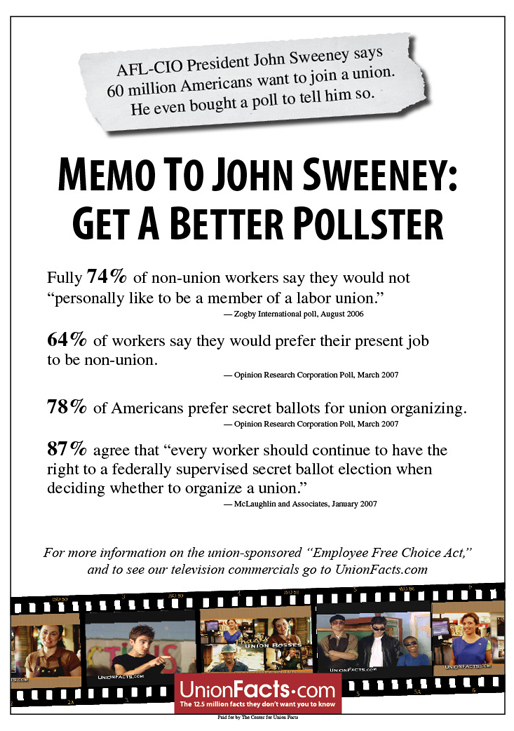
Memo To John Sweeney: Get A Better Pollster

Union bosses have been cooking the books. As they attempt to end secret ballot elections for employees deciding whether to join a union, labor chiefs claim to have a groundswell of support. The real numbers tell a different story.

The AFL-CIO commissioned a study – which they won’t release – claiming that 60 million Americans want a union. But prestigious polls, including questions originally crafted on behalf of the AFL-CIO and recently commissioned by the Center for Union Facts – suggest most Americans don’t want to join a union and they don’t want union bosses stealing their right to a personal, private vote. Consider:

  • Fully 74% of non-union workers say they would not “personally like to be a member of a labor union.”
    — Zogby International poll, August 2006
  • 64% of workers say they would prefer their present job to be non-union.
    — Opinion Research Corporation Poll, March 2007
  • 78% of Americans prefer secret ballots for union organizing.
    — Opinion Research Corporation Poll, March 2007
  • 87% agree that “every worker should continue to have the right to a federally supervised secret ballot election when deciding whether to organize a union.”
    — McLaughlin and Associates, January 2007

Unions Working With Elected Officials To end Elections

No sooner did the balance of power shift in Congress than did labor union leaders renew their call for the passage of the so-called "Employee Free Choice Act." This misnamed legislation would end the rights of employees to secret ballot elections when determining whether they wish to unionize, instead subjecting them to "card check." Under card check, unions can win new members simply by collecting signatures on cards, a system under which employees have no right to a private vote on whether unionization would be best.

Without any sense of irony, many of the politicians sent to Washington by secret ballot election are now laboring to end secret ballot elections in the workplace. Card check is a process that's rife with fraud and intimidation by union organizers, a fact that probably helped drive 75 percent of Americans to affirm in our poll that secret ballot elections are the fairest way of deciding union representation. Only 11 percent of respondents supported card check, which union leaders hope Congress will now make law.